Sunday, November 11

ONE BIG REASON WHY I WROTE MY FIRST BOOK


This blog has moved to my website at 

www.susannafreymark.com 

Something happened in the writing of my book blurb. Something profound.

I have, in the last few months, been caught up in editing, page proofing, approving book covers and becoming a dot.com in preparation for the launch of my first fiction book.

The copy edit was intense and those who know me on Facebook would have heard me groan about having to go over and over my words.

Yet the synopsis was written by someone else and the first time I saw it was on the publisher's website listing the February releases.  While I cringed at the over use of adjectives, which is standard for a book blurb, there was a line summarising the book that floored me.

'Losing February, describes, in sometimes disturbing graphic detail, what happens when a strong energetic, capable woman in her early 40s completely loses her sense of herself and mistakes grief for punishment.'

Wham. That line hit me hard.

' . . .  mistakes grief for punishment.' 

That is exactly why I had written this book but I didn't know that — I hadn't understood that — until I read that line.

I don't know the name of the person who 'got it' but I'd like to find out and thank them.

In my mind, there were many reasons why I had written this story but I hadn't articulated it in such a concise way. There it was. The Truth, with a capital T.

Losing February isn't published until next year.
I am excited and terrified all at once. It is out of my hands yet still so much a part of me.

The cure: start another book, writer friends tell me.

But I am still processing what I have learnt in writing this one, and I still haven't let go.

But I'm close.

Very close.


Read more about Losing February here

Saturday, September 1

I DO, I DO, I DO


In between finishing my book, revisiting a short story and writing articles for the education pages of the newspapers — in between all this writing are the most important words to write and get right.

  
from planetarybargains.com
                                                             
Wedding Vows.

It even sounds important.

And it is important.

There is so much I could write yet I want to keep it brief and to the point.

And I want it to mean so much.

That is a lot of pressure on a few words.

I'd like to steal these words from The Invitation.


It doesn't interest me what you do for a living.

I want to know what you ache for, and if you dare to dream of meeting your heart's longing.

It doesn't interest me how old you are. I want to know if you will risk looking like a fool for love, for your dream, for the adventure of being alive.

I want to know if you can be alone with yourself and if you truly like the company you keep in the empty moments.

But they are not my words. They belong to Oriah Mountain Dreamer

And in my moment of declaration I need to find the right words to express my love and gratitude to the man I am going to marry.

It is at times like weddings, funerals and other significant life moments that words seem inadequate. Or over used. But they are what we have.

And if I thought writing a synopsis was hard, my wedding vows are going to take some work.

All I have so far are the words, I Do.

It's a good start.


Saturday, April 7

Love, cakes and being enough


'Never write about your family or about sex.'


—Kate Holden, author of In My Skin said in the latest issue of NewsWrite.


I've ignored her advice and have written about my mother, her secret cakes and her distance. 


Mother's Secret Recipe features in Candida Baker's new book  Wisdom of Women.


Mother's Secret Recipe


She holds out the photo in its expensive silver frame.

'I put this by Dad's bed, in hospital, you know, when he started forgetting things.'

She is proud of this and getting the frame at a reduced price was a bonus.

‘I thought it would comfort him to see the family,’ she adds.

It’s a kind thing to do when a man is dying. 

I take the photo from her hands. 

Peter, the eldest, stands at the back and his arms hang by his side like strands of seaweed. Monika stares straight ahead while Sylvia, the peace-maker of the family, flashes her wide smile. Mum, so much smaller than the rest, stands next to Dad who towers over her. 

The illness is there in Dad’s eyes but not his body — not yet. 

I count the people in the photo. 

Five, I count again to make sure. 

My mother is busy tidying the shelves behind me. 

‘I’m not in the photo,’ I state as plainly as I can.

She stops re-arranging the clean shelf and looks at the picture.

‘Yes, you are,’ she says.

I pass her the frame and she peers at her family huddled together in the car park outside the restaurant. She keeps staring at the picture as if somehow I will emerge. 

‘Look, five people,’ I move closer and my voice rises, ‘one, two, three, four, five.’

She stares harder. 

‘I’m not in it,’ I say again.

She puts the photo back on the shelf and sighs. I wait for her to say something but she moves across the study to wipe more ornaments.

A large, square photo of my father's face sits in a glass frame on the desk. It’s the same picture that sat on his coffin at the funeral service. 

Now it lives here in front of the computer where he spent most of his afternoons. 

I’m puzzled by my mother’s choice – how could she choose this photo? It’s not deliberate, I know that, she’s been under a lot of stress with years of Dad’s illness and she’s tired. 

But she’s always been tired. 

After four children, she ran out of mothering and left my sisters to pick up the pieces. 

Monika resented it the most. Her seething anger towards me was thinly veiled on the few occasions the family came together.

‘You were so spoilt,’ she declared after copious amounts of scotch.

I never found an answer for her accusations and felt anything but spoilt. 

My mother was busy, she had a house to clean and beautiful cakes to make. 

Sweet blueberry crumble, crunchy apple tart, cheesecake, buttercream sponge, moist banana loaf; they all tasted delicious. 

She liked nothing better than to retrieve her best white tablecloth from the linen cupboard in preparation for a spread. 

Never just one, guests were treated to a feast of three or four cakes.

Yet when these feasts were over, everyone looked satisfied except my mother. 

The guests had admired her cakes and stroked the fine china cups but when she cleaned up after they’d gone, she complained with a bitterness in her voice as sharp as the lemon icing on the carrot cake. 

‘Who does Sophie think she is, and what about Annie, no wonder her husband isn’t interested in her the way she dresses . . .’ 

I sang inside my head to blot out the words.They were like poison spreading over the cake crumbs sitting on the empty plates. 

As soon as I could, I sneaked outside and threw the ball to our dog, Rex, at the far end of the backyard.

‘How could you forget me?’ I say out loud. 

She ignores the difficult question and heads into the kitchen.

‘I’ll make your favourite tonight,’ she announces,’ you know the fluffy omelette you like.’

This is all I’m going to get. 


A special dinner and inane chatter about the neighbours and friends who have let her down, dressed inappropriately or offended her by not mowing their front lawns when she thought they should.

I take another look at the photo. 

Nup, not there. 

I turn and look at the photo of my father’s face. 

We used to pretend to fight for the biggest slice of my mother’s latest baking creation or we stole pieces when she wasn’t looking. 

‘Don’t tell your mother,’ he’d say in jest.

Her eyes shone when Dad and I argued over the last piece of apple strudel. 
She’d cut it in half and give Dad the bigger slice. 
He piled whipped cream on top and I copied him. 
We never seemed too full for more cake. 

Since Dad died I’d lost my appetite for cakes. 

When afternoon tea was served, I took a small slice and spent most of the time moving the cake around the plate until it looked misshapen enough to not draw attention to my lack of enthusiasm.

While Mum and Monika ate and gossiped, I put on my ipod and blotted them out. They said I was rude. 

‘I can’t hear you,’ I called through strains of the Rolling Stones.

Monika nodded as Mum talked about the fat woman she’d seen at the mall, and how disgusting the woman looked in shorts. 

I turned up the volume until their voices disappeared into the background.

I started to visited less, even though it was only two hours drive north on the Pacific Highway. 

When my mother rang I pretended I was busy and could only talk for a moment. Her rant about the lady at the shops who gave her the wrong change was cut short.

‘I have to go Mum, the kids are calling.’

I edited myself so much around my mother that I forgot how to be her daughter. 

She offered me recipes. Secret cake recipes, written in spidery scrawl in notebooks tied together with brown string. 

Do you want to know how to make the chocolate biscuit cake? Aaah, the chocolate biscuit cake, the one with rum in it. 

For years we had all begged her for the recipe.

That’d be great Mum, I lie, next time I come up, that’d be great.

It was a long time between visits. Sylvia phoned and asked when I last saw Mum.

‘She says you’ve been busy,’ said the middle sister, who lived across two states.

'I have,' I say and I ask about the kids, her job and their next skiing trip.

When Monika starts to call, it becomes tricky. Her accusations target my neglect and how I’ve never cared about Mum. She raves at me while I rearrange the fridge magnets. 

This family I belong to holds no nourishment for me; it’s a pretense. 
I want to tell Monika that but there’s little point. 

Her idea of family bonding is shopping. She showers my mother with expensive perfumes and designer shoes. She bought Mum a dress for $780 to wear to Dad’s funeral. 

Mum took it out of the wardrobe and showed me when I visited, it’s Channel, she said every time. 

Love, according to my mother, is measured in gifts; the more costly the item, the more love it holds. 

My homemade presents and photos of the kids were stashed at the back of the shelf. Or put in my mother’s drawer of unwanted gifts. 

My bond to the family thins and I give up on the presents — and the cakes.

Months pass and the visits to my mother’s house are less frequent. It’s every second month now and my excuses become more feeble. 

Our lives are distant and even though I hear repeats of the stories about her neighbours and the shocking things they’ve done, I don’t hear the words anymore. 

‘Okay,’ I cut her off mid sentence, ‘I have to go, lots to do Mum.’

The distance becomes comfortable and we slip into half yearly visits and monthly telephone conversations. I rely on my sisters to occupy my mother’s loneliness as I struggle to be a good enough daughter by proxy.
On a bright Saturday morning, Nina is at a loose end. Her usual social life has become unhinged and she’s looking to me for entertainment.

‘Hey Mum, let’s make a cake.’ 

She’s excited and pulls old greasy tins out of a forgotten cupboard in the kitchen. The noise of metal on metal jars me and Nina senses my impatience.

‘I can do it on my own you know but then you can’t eat any,’ she says.

Relenting, I take the butter from the fridge so it can soften before its beating. Nina lines up jars of sultanas, chocolate bits and sugar. 

She has a natural instinct for the ingredients but is unsure of the correct amounts.

'Let’s ask Granny, she knows a lot about cakes,’ she says. 

I cringe.

Nina jumps across the kitchen and grabs the phone.

There is excitement in her voice as she tells Granny about our domestic adventure. 
She barely leaves room for her grandmother to reply and is breathless when she gets off the phone and relays the instructions. 

She gathers the mixing bowl and sifts the flour as she tells me some of Granny’s special secrets. 

I cream the butter and sugar while Nina adds the choc chips. 
We work together like this with my mother’s baking wisdom between us. 
I laugh at how Nina interprets the advice and how she adds extra chocolate to the mixture.

‘Did Granny say to do that?’ I say.

‘No, but she didn’t say not do it,’ Nina says.

I laugh and together we pour, we mix, and then grease the tin before putting our masterpiece into an over-hot oven. 

It’s a lumpy looking cake but neither of us, with our flushed cheeks from the warm kitchen, seem to care. 

The phone rings and I pick it up. It’s my mother.

‘Yes, the cake is in,’ I say.

‘It doesn’t quite look like yours,’ I add.

‘You never were much of a cook,’ my mother says.

This is true.

‘No, I wasn’t,’ my voice is quiet. 

There are no words left. 

A slow silence hangs across the telephone like an empty washing line. 

‘Mum.’

‘Uh-huh,’ she says.

‘Mum, I have to go.’

I lower the phone and rest the handset in its cradle.I stand right where I am and watch my daughter peer into the oven.

When the cake is cooked, we use bright blue food dye and make the most magnificent icing ever and smear it over the the top of the cake. 

I make tea and we sit at the long, wooden table in the middle of the kitchen and sip our tea and eat warm, blue cake. 

We lick the crumbs off the plate before we reach for a second piece.


_______________________________


Sunday, February 12

MY BIG PENCILS


Get out of the way.
Sharpen the pencils.
Clear the desk.
I can feel a writing binge coming on. And about time.

I love the satisfaction of the increasing word count of my manuscript. I take pleasure re-reading what I've written and taking out the excess words and tightening the story as if it were a corset.

After all the advice I've had from other writers and reading self-help writing books, at the end of the day it is about turning up at the desk, as Hemingway said.

That is exactly what I'm doing. I have one last subject left in my Masters in Writing at UTS where I will work on my book, one-on-one with a mentor.

It is a luxury and I want to make the most of every moment. By the end of June I want to post a huge HOORAY! here.

Losing February will be finished and will need a strong edit. I feel like a writer when I work like this. When I finally decide that there has been enough indecision and waffling about.

Time to sharpen the metaphorical pencil and write.

40,000 words in, 40,000 to go.

Just watch me.


  1. Pic: This remarkable photo was sent to me. Who was the sculptor? I'd like to attribute them. 

Thursday, January 5

5 WRITING LESSONS ON LOSING AND WINNING

Isn't January the time to take stock?

To put your cards on the table and look at the hand you've been dealt?

If you want to change something in your life, don't wait until this January or the next one.

The Dalai Lama's life lessons came across my desk. They've been around for a few years but there they were again — stating the obvious.

The lessons made me think about my own writing process. I have adapted some here from the original - and applied them to my writing to support me in finishing the final subject in my Masters.

Here's a few gems I've stolen from the Dalai Lama.

#1 When you lose, don't lose the lesson.
Such an important one this one, this one. Recently I found out, none of my short stories were selected for the UTS Anthology after submitting three. I was too cocky and was certain at least one would be chosen.  It was a good lesson in expectations and trying harder. If I become complacent as a writer I won't improve. Write better, learn more. 


#2 Spend some time alone every day.
I love time alone but find it hard with a five-day -week job and living in a house of four, sometimes five people. My alone time is in the garden, with the chooks and on the ferry. I grab it where I can and always find it creative.


#3 Learn the rules so you know how to break them properly.
I'm still working on this one. I'm still learning the rules. Still learning how to break them.

#4 Remember that silence is sometimes the best answer.
Yes, tell me this one again . . . and again . . .  and again. In writing, silence is about - NOT overstating a point or an expression. Let the reader fill in the gaps.


#5 Remember that not getting what you want is sometimes a wonderful stroke of luck.
So many stories I could write about the twists and turns of life and how not getting what I wanted or expected was exactly what I needed. One example: having my first rejection from a publisher and throwing out 40,000 words (mainly backstory) of my manuscript. The story is all the better for it.


Whatever works for you, just do it. If it doesn't, discard it and try something else. And keep writing.


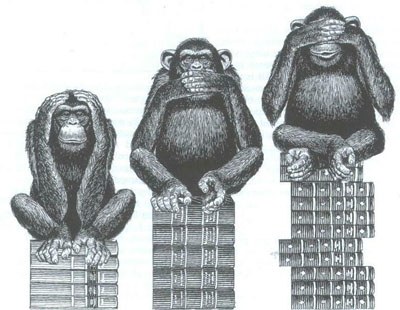
Monkey business picture from images

Saturday, November 19

FRIENDS IN FICTION


Am I in it?

I have a friend who asks this every time I finish a story. Is she in it?

One day I finally said, yes, you are.

After years of wanting and asking to be part of the busy, made-up fictional life in my head, there she was.

Wednesday Lunch is a short story. And she is in it.

Like most of what I write, the story is based on a truth. In this case a real event - a lunch - with said friend and another girlfriend where we discussed some taboo topics in the way good friends do.

Now, while the lunch and the conversation happened, the story in its writing and wresting from real-life into fiction has become, in the process, something else altogether.

Suddenly she wasn't sure if she wanted to be in a story.
What if someone recognised  her?

They won't I said, it's fiction.

What was her fictional name?
Gemma, I told her.
I don't like Gemma, she said, why am I Gemma?

It isn't you, not really, I reassure her.
It's fiction I keep saying but I know this word isn't making sense to her.

The lunch was a spark for the story but the characters are made up, I tell her.  She nods.

I'm not surprised she's confused. I manage to confuse real-life with my imagination and the sorting process in my head. Maybe that is why I love to write fiction.

So when you read Wednesday Lunch when it is published one day, you won't recognise anyone you or I know because it is fiction.

Right. Got it?


Lunch anyone? Pic taken at Sculpture by the Sea in 2010.


Sunday, October 2

OH THE SHAME.


Shame, as an emotion, can take on biblical proportions but in writing, shame can be the compass to a story.

At Short Story Fiction Writing at uni, my lecturer, Tegan Bennett Daylight, encouraged us to write about a point in our lives where we felt shame.

I chose two moments. One where I had pretended to be something I wasn't and another where I told a big, fat lie.

Oh, such juicy stuff for a writer. But writing the words and re-living the secret moments in a fictional setting was exposing.

The first moment was one, where for two years, I hid my divorce from my parents.
I justified my decision because my father was ill — dying in fact.

What better excuse could I have?

The truth was — I was too scared to tell them.

I was caught up in their potential disapproval and the tut-tutting of my mother.
Whenever she mentioned someone who was divorced she would lower her voice — softer than a whisper and say the word very slow. D-I-V-O-R-C-E.
She would brag about how in our family we'd had never had a D-I-V-O-R-C-E.

My pretence extended to cleaning my ex's house and having family meals with my parents when they visited. It was an elaborate facade, I'd even bring objects from my house so it looked like I still lived there.

This shameful lie has been turned into a short story called The Visit.
It was raw to write, even though the shame of that lie was at least four years ago.

My Dad died without ever knowing his youngest daughter was divorced and when I told my mother she assumed my ex had been terrible to me.
He hadn't, we had simply come to an end of a 20-year marriage but remain friends and keep our family unit as tight as we can despite our separation.

My big lie — I'm not ready to write about that one. It is a lie of the heart. It is about love and those are the hardest stories to write.

More shame, more stories.


Pic taken at Sydney's Luna Park. Now, who are they laughing at?


Saturday, September 3

READING ON A JET PLANE


Come on, Mr Joyce, give me a hand.
(pic of things on my desk- Sept '11)
I am on the search for a short story for a looming uni assignment. So I asked for recommendations on FaceBook and ended up with this must-read list.

Hills Like White Elephants - Hemingway
Kiss Kiss - Roald Dahl
The Labyrinth - Jorge Luis Borger
Twelve Red Herrings - Jeffrey Archer
Cowboy - Thomas McGuane
Fat Man in History - Peter Carey
A Perfect Day for Bananafish - JD Salinger
Anything written by Steinbeck
The Dying Gentleman - Tim Winton
The Persimmon Tree - Margaret Barnard
A&P - John Updike
If I loved you I would tell you this - Robin Black

I need to select one — just one — and write a critical essay on it.

I was taken with Robin Black's book about love. The mystery of what might be revealed drew me in just by the title.
But I couldn't find the book in my local bookshop  and with a five-hour return flight to Adelaide next week I wanted to use the time on the plane to read, read, read.

So I checked out my own bookshelves.
There was Tim Winton, David Malouf, Helen Garner, Frank Moorhouse, Alice Munro, AS Byatt and Annie Proulx, Karen Hitchcock and my favourite deafult author, Raymond Carver. All deserving of a second read and critical analysis.

I was drawn to Malouf — and Garner. Malouf 's seductive story style always holds me but I spend too much of my reading time marvelling at the poetry of his prose. And Garner's At the Morgue is a detailed and hard-hitting piece of literary non-fiction that gives me shivers every time I read it.

So how to decide.

Oh look there is another book on my shelf - Best Australian Stories 2006.
More choices.
More reading.
Oh goody.

(Thank you to Mark x 2, Meredith, Melissa, Jane, Lisa, Zena, Nadine, Victoria, Linda and Northern Rivers for your story suggestions.)

Sunday, July 24

5 names NOT to use in a novel


The names you choose when writing a story have to fit the character perfectly. Until I have the name right, the character I am writing doesn't quite gel. 

Five names to never use — for obvious reasons — Hitler, Jesus, Bruce, Davo and Lady Gaga. 

The list goes on . . .  a famous name, a name that reminds me of someone I taught years ago, a name that is old fashioned or a name that has become trendy like Harper - this affects how workable a name is for a character.

Until I get the name right — the character cannot be fully formed.

In my current work-in-progress I use initials until I can find the 'right one.'

With my manuscript Losing February I wait for the characters to form their own names. 
But when will DB find his name? I know him, I know what he does, how he feels, but his name . . . it hasn't come yet.

Names, like titles can be changed but I can get too attached to a title. 

In my first novel writing attempt I was so stuck on the title The Perils of Wearing a Tutu that it took me a long time to respond to advice to change it. The whole tutu thing sounded like chick-lit, not there's anything wrong with that but the story clearly wasn't chick-lit. 

I changed it to — Drowning on the Way Home. And it altered the whole way I saw the story. All references to tutus were dropped and I focused on what the story was really about - belonging and finding a home.

Nothing is set in stone. Not names, not words, not me. 

Monday, June 13

TOO MANY WORDS


Does anyone else have the problem of too many story ideas?

Is this concept as annoying as a skinny person complaining that they can't put on weight no matter how many Kitchener buns they eat?

The problem is not having the ideas, it is writing them all down.

And when I have written the first - or second - or seventeenth draft of a story -  I like to carry a hard copy in my bag.

Like a pregnancy, for months, I carry the story with me and take it out on the bus, at the cafe — anywhere I'm waiting.

I need time for the story to grow. I change things, move scenes around, take out lots of stuff I thought was important and generally tighten the story.

Sometimes this tightening process takes a whole year.

There is always a queue of stories waiting to be told. They're just waiting for me to listen, a writer friend once told me.

It's one of the reasons I love writing so much. 

Friday, May 6

THE THRILL OF WORDS

Launch on May 20 at 4.30pm at
Wharf 2 at the Sydney Theatre Company 
It will be a thrill to see my story 'out there.'
And to see my name in print.

And it will be such a thrill to be at the book launch at the Sydney Writers Festival.

The UTS Anthology The Life You chose and that chose you is out (soon).

I am - of course - biased and think the book looks great.

I believe I may burn the letters of each word of my story Middle Brother by reading it so many times.

Woo-hoo!

Celebrations aside, the fact that a university is prepared to put time and money to produce such a professional publication is heartening.

There are limited avenues for writers and to be included in something so smart and worth reading is - well, it is a thrill.

But I 've said that already - many times.

See for yourself - check out http://www.figment.com.au/uts-writers-anthology-2011.html#tp

I know, I know. But I can't help cheering - and clapping.


Thursday, March 24

TOPLESS PINEAPPLES - words as labels

When words make you laugh
- a sign outside Foodland in Bangalow.
Modernism, postmodernism, poststructuralism, postcolonialism and posthumanism . . . and don't let me forget neorealism and narratology.

Yes, I'm doing Theory of Writing at uni.

The upside of all these isms is that I have to understand the texts on the subject reading list.

Virgina Woolf, James Joyce (never got him, maybe this time I will), Helen Garner (my hot favourite), Flaubert's Madame Bovary (someone strangle Emma please), Ted Hughes and Sylvia Plath, Edgar Allan Poe, Kurt Vonnegut (weird, weird but wonderful) and Eva Homung with her strangely poignant Dog Boy, about a boy living with wild dogs.

As long as the theory doesn't get in the way of a good story.

I know at uni, at least, we need to understand where the literature fits in the grand scheme of things. We learn to label stories and see how they are a reflection of the times in which they were written.

A good story is a good story - whether it was written yesterday or in another century.

Words travel through time and while we study the influence of literature at universities the reason these words of the authors I mentioned have survived is because they mean something to us even now- despite what ism they fall under.


Sunday, February 27

FIXING WORDS


I spent the last two weekends editing  Middle Brother for this year's UTS anthology.

I didn't do this alone. An editor was assigned to work with me to get my story in shape before it went to a copy editor.


Every word was analysed. Should it be this, should it be that? Should it be deleted?
I'd edit, read the story aloud, edit some more. Each change made something else 'stick out.'

Kate, my editor suggested changes and most of them were spot-on. Her ideas about changing a word or fixing a bit of dialogue made a world of difference.

When I sat down a week later and looked at the story with 'fresh eyes' it was much better.

It read better because of the fixing, cutting, sawing a sentence in half - making it more punchy, making it flow.

And because the story was written from a young boy's point of view, every word had to be what a boy would say and think. His fart, his fight with his brother, begging his dad for lollies – the words had to be as real as the ten-year-old boy.

What a process. Intense, wearing, frustrating but so, so worth it.

When I see it in print, I'm sure I'll see more words to fix.

I reckon though, I will be so thrilled about my little story being in a book, that I will be literally jumping for joy.

Pic taken at 2010 Sculpture by the Sea of Giant Pencil Shaving